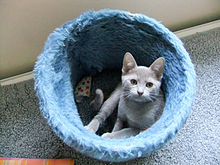
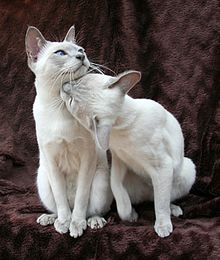
The Governing Council of the Cat Fancy recognizes Korat-type cats differing from the traditional solid blue appearance of the Korat on their experimental register. Such cats are registered as Thai Lilac if they are solid lilac. A Thai Blue Point exhibits the colourpoint pattern also seen in Siamese. A Thai Lilac Point also exhibits the colourpoint pattern also seen in Siamese, but in addition exhibits the Chocolate gene. These should not be confused with the Thai cat, a new name for the original (traditional or classic) Siamese cat type, with a rounder face and thicker body than modern "ultra-typed" Siamese.
The policy for full registration of Korats only allows blue cats of full-registered parents or third-generation supplementary-registered parents.[5] It also requires genetic testing for gangliosidosis to be carried out to ensure that the breed remains free of this inherited disease which once existed in some Korat and Thai breeding lines.
The genes responsible for Pointeds and Lilacs were introduced into the Korat breed when new Korat breeding stock carrying the recessive genes was imported from Thailand. The first recorded Thai Lilac kitten was born to the Jenanca line in 1989, when "Jenanca Lilac Lillee" was born from two Korat parents in the U.K.. In 1990, Lillee's parents were re-mated with more lilac kittens resulting. A young male lilac was then born to another pair, also in the U.K., allowing more crossings without inbreeding too closely.[1]
The first recorded Thai Lilac Point was born to the Clairabelle line in 2014 when Clairabelle Pixie Dust was born from two Korat parents in the U.K.. A re-mating from the same parents resulted in another Thai Lilac Point, this time a boy, Clairabelle Ninja Rococoa. A third and fourth Thai Lilac Point has recently been born into the Jusarka line.